Roulette looks simple from a distance. A wheel spins, a ball drops, and a number wins. But sit down at a live roulette table for the first time, and the betting layout can feel like a puzzle. This guide walks you through every standard bet in live roulette, what it pays, and how likely it is to win, so you can place your chips with confidence.
How the live roulette table is laid out
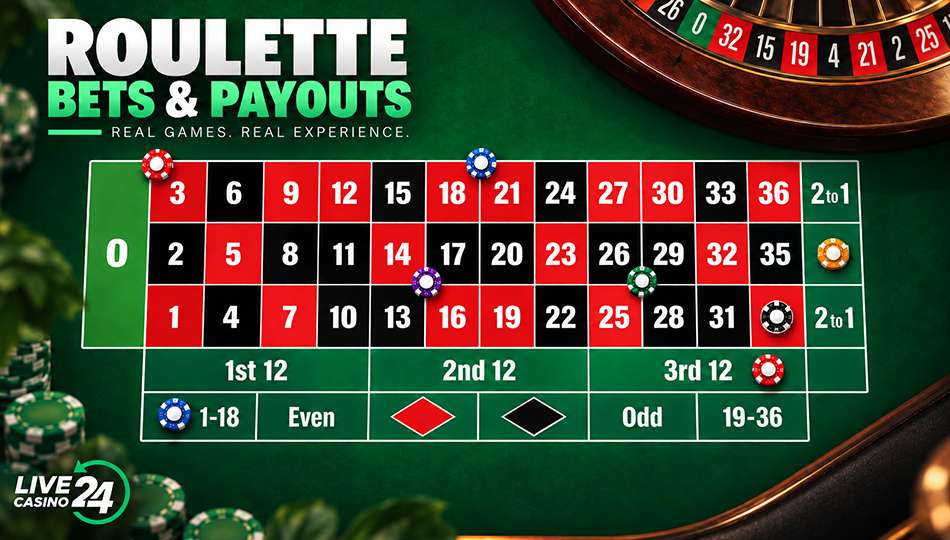
Every live roulette table has two parts. The wheel, run by the dealer, and the betting layout, which appears on your screen. The layout shows the numbers 1 to 36 in three columns of twelve, coloured red or black, with the green zero sitting at the top. On European and French tables, there is a single zero. American tables add a double zero, which changes the odds, as we explain below.
The numbers grid is where you place inside bets. The boxes around it, covering things like red or black, odd or even, and the dozens, are for outside bets. Understanding this split is the key to reading any roulette table.
Where to Play Live Roulette Games?
You can play this game at every casino below. Each one meets our criteria for a good live casino experience. You can read what they are on our casinos page.
When you sign up through a link below, the casino may pay us a commission. This does not cost you anything. It also does not change how we score games.
-

New Player Offer
500 Bonus Spins on Love Island + get $50 in Casino Bonus
Payment methods


 American Express
Providers


-

Bonuses and Rewards Vary by State
Payment methods


Providers

Inside bets: higher payouts, lower odds
Inside bets are placed on the numbers grid itself. They pay more because they cover fewer numbers, which means they win less often. Here are the six standard inside bets.
Straight up
A bet on a single number, including zero. It pays 35 to 1. On a single-zero wheel, there are 37 pockets, so your chance of hitting is 1 in 37, or about 2.7%. At 35 to 1, it has the highest standard payout on a traditional roulette table.
Split
Place your chip on the line between two adjacent numbers, such as 8 and 9 or 8 and 11. If either wins, you are paid 17 to 1. Your chance of winning is roughly 5.4%.
Trio
A trio is a three-number bet involving zero. On a European table, you can bet on 0-1-2 or 0-2-3 by placing your chip on the appropriate intersection. It pays 11 to 1 and has a 3-in-37, or roughly 8.1%, chance of winning.
Street
A street covers three numbers in a horizontal row, like 13, 14 and 15. The chip goes on the outer edge of the row. It pays 11 to 1 and wins about 8.1% of the time.
Corner
Also called a square bet. Your chip sits on the intersection of four numbers, for example 17, 18, 20 and 21. A corner pays 8 to 1, with roughly a 10.8% chance of success.
Six line
Sometimes called a double street, this bet covers two adjacent rows, or six numbers in total. Place your chip on the outer edge where the two rows meet. It pays 5 to 1 and hits around 16.2% of the time.
Basket and first four
On a single-zero table, the first four bet covers 0, 1, 2 and 3 and pays 8 to 1. On American double-zero tables, the equivalent basket bet covers 0, 00, 1, 2 and 3 and pays 6 to 1. The American basket has the worst house edge on the table, at 7.89%, so most experienced players avoid it.

Outside bets: steadier results, smaller payouts
Outside bets sit around the edge of the layout and cover large groups of numbers. They win more often but pay less. They are the natural starting point for anyone new to live roulette.
Red or black, odd or even, high or low
These three are the even-money bets. Each covers 18 numbers and pays 1 to 1. High covers 19 to 36, low covers 1 to 18. On a single-zero wheel, each of these wins 48.6% of the time. The zero is what tips the balance in the casino’s favour, because it belongs to none of these groups.
Dozens
The table is split into three dozens: 1 to 12, 13 to 24 and 25 to 36. A dozen bet pays 2 to 1 and wins about 32.4% of the time.
Columns
Each of the three vertical columns on the grid holds twelve numbers. Betting on a column also pays 2 to 1 with the same 32.4% chance as a dozen. The difference is which numbers you cover. Columns mix numbers from across the whole wheel, while dozens group them in sequence.
| Bet | Numbers | Payout | Win chance |
|---|---|---|---|
| Straight up | 1 | 35:1 | 2.70% |
| Split | 2 | 17:1 | 5.41% |
| Street | 3 | 11:1 | 8.11% |
| Corner | 4 | 8:1 | 10.81% |
| Six line | 6 | 5:1 | 16.22% |
| Dozen | 12 | 2:1 | 32.43% |
| Column | 12 | 2:1 | 32.43% |
| Red/Black | 18 | 1:1 | 48.65% |
| Odd/Even | 18 | 1:1 | 48.65% |
| 1–18 / 19–36 | 18 | 1:1 | 48.65% |
Racetrack bets: the French favourites
Many live roulette tables from Evolution, Playtech and Pragmatic Play include a racetrack betting interface, an oval strip showing the numbers in the order they appear on the wheel. This lets you place call bets that cover physical sections of the wheel rather than areas of the layout.
Voisins du Zéro covers the 17 numbers around zero using nine chips. Tiers du Cylindre covers the 12 numbers opposite zero with six chips. Orphelins covers the eight remaining numbers using five chips. Jeu Zéro is a smaller version of Voisins that covers seven numbers with four chips. A neighbours bet covers a selected number and nearby numbers on either side of it on the wheel. A common version covers the chosen number plus its two neighbours on each side, for five numbers in total, although the number of neighbours can vary between live roulette interfaces.
These bets do not change the house edge. They are a convenient way to place several inside bets at once, and many players enjoy them because they follow the wheel rather than the grid.
The house edge and why the zero matters
The zero is what creates the casino’s mathematical advantage on standard roulette bets. A straight-up bet, for example, pays 35 to 1 even though a single-zero wheel has 37 possible outcomes. That gap is the house edge. On a single-zero wheel, this gives the casino a 2.70% house edge on standard bets. On a double-zero American wheel, with 38 pockets, the house edge on most bets rises to 5.26%. The exception is the five-number bet (0, 00, 1, 2 and 3), which has a much higher house edge of 7.89%.
This is why we always suggest choosing a single-zero live roulette table when one is available. The payouts are identical, but you lose less over time. Better still, look for a French roulette table with the La Partage rule, which returns half your even-money stake when zero hits. That cuts the house edge on those bets to 1.35%, the lowest you will find in any live roulette game.
Which bet is best?
No bet beats the house edge, and no betting pattern changes the fact that the odds favour the casino over the long run. What you can choose is how the game feels. Even-money outside bets give you more frequent, smaller wins and generally produce less volatile bankroll swings than inside bets. Straight-up numbers and splits give you rare but much bigger wins. Many players mix the two, placing a small stake on a favourite number alongside a larger outside bet.
If you are just starting, choose a single-zero table and begin with small outside bets while you learn the layout. Set your budget and session limit before you start, rather than increasing your stake to chase losses. Once you can read the layout comfortably, add a corner or a six line and see how the rhythm of the game changes.
Play responsibly
Live roulette is entertainment, not a way to make money. Set a budget before you play, decide in advance how long you will stay at the table, and stop when you reach either limit. If gambling stops feeling like fun, free and confidential support is available. Visit our responsible gambling page for help in your country. 18+ only.