Some blackjack hands are simply bad. You look down at a hard 16, the dealer shows a 10, and every option feels like a loss. At tables that offer surrender, you have one more button: give up the hand and take half your stake back.
It feels like quitting. But used at the right moments, surrender is one of the few decisions in blackjack that lowers the house edge. In this guide, we explain what surrender is, the two versions you may find at a live table, the exact hands where it makes sense, and the mistakes we see players make with it.
What Does Surrender Mean in Blackjack?
Surrender lets you fold your first two cards before you do anything else. The hand ends straight away; you lose half your bet, and the other half goes back to your balance. On a €10 bet, you get €5 back.
A few rules apply almost everywhere:
- Surrender must be your first decision. Once you hit, double, or split, the option is gone.
- It only applies to your original two cards, not to hands created by a split.
- The table has to offer it. Many live blackjack tables do not.
Why would you ever give up half your money? Because some hands lose, on average, more than half of what you stake. If a hand costs you around €0,54 per €1 when you play it out, handing over exactly €0,50 is the cheaper choice.
Where to Play Live Blackjack?
You can play this game at every casino below. Each one meets our criteria for a good live casino experience. You can read what they are on our casinos page.
When you sign up through a link below, the casino may pay us a commission. This does not cost you anything. It also does not change how we score games.
-

New Player Offer
500 Bonus Spins on Love Island + get $50 in Casino Bonus
Payment methods


 American Express
Providers


-

Bonuses and Rewards Vary by State
Payment methods


Providers

Late Surrender vs Early Surrender
Late surrender
Late surrender is the version you are most likely to see. You can only surrender after the dealer has checked for blackjack. If the dealer has blackjack, you lose your full bet, and the surrender option never comes up. Used with correct basic strategy, late surrender typically lowers the house edge by around 0.08 percentage points.
Early surrender
Early surrender lets you fold before the dealer checks for blackjack. That makes it far more valuable, because you can escape a hand even when the dealer is holding an Ace and a ten. Early surrender is much more valuable. When it is available against both a dealer 10 and Ace, it can reduce the house edge by roughly 0.6–0.7 percentage points, depending on the table rules.
Check the rules at no-hole-card tables
At some live tables, the dealer only draws a second card after all players have acted. How surrender works there depends on the game. Before you rely on it, open the help menu and read exactly when you can surrender and what happens if the dealer then makes blackjack.
When to Surrender: The Basic Strategy Hands
Surrender is only useful on a handful of hands. For the most common live setup, six or eight decks with late surrender, the list is short:
| Your hand | Dealer shows | Late surrender? |
|---|---|---|
| Hard 16, except 8,8 | 9, 10 or Ace | Yes |
| Hard 15 | 10 | Yes |
| Hard 15 | Ace | H17 only |
| Hard 17 | Ace | H17 only |
| 8,8 | Ace | H17: surrender / S17: split |
| Anything else | — | No |
Just as important is what not to surrender. Never surrender a soft hand such as Ace-5; it cannot bust on the next card. Do not surrender a pair of 8s against a 10; split them instead. And hard 12, 13, or 14 are not bad enough to fold, even against a strong dealer card.
If you have read our guides on doubling down and splitting pairs, you will notice a pattern: basic strategy is about small edges. Surrender is the same. It is not a rescue button for every uncomfortable hand.
Why It Works: A Quick Look at the Maths
Take the classic surrender hand: hard 16 against a dealer 10. If you stand, you only win when the dealer busts, which happens roughly one time in five with a 10 showing. If you hit, you bust on any card from 6 upwards. Either way, the expected loss is around 54% of your stake. Surrendering fixes the loss at exactly 50%.
Two points are worth stressing. First, this is an average, not a promise. You will sometimes surrender a hand that would have won. Second, surrender reduces the house edge; it does not remove it. Blackjack still pays the casino over time.
Common Surrender Mistakes
- Surrendering too often.
Folding 12 against a 10 or 15 against a 7 costs you more than playing the hand. - Confusing surrender with insurance.
Insurance is a separate side bet with a high house edge. Surrender is a strategy decision on your main hand. - Assuming every table has the same rules.
Surrender, soft 17, and the number of decks all vary between tables and providers. - Surrendering because of a losing streak.
Earlier hands have no effect on the next one. Stick to the chart.
Where to Find Surrender in Live Blackjack
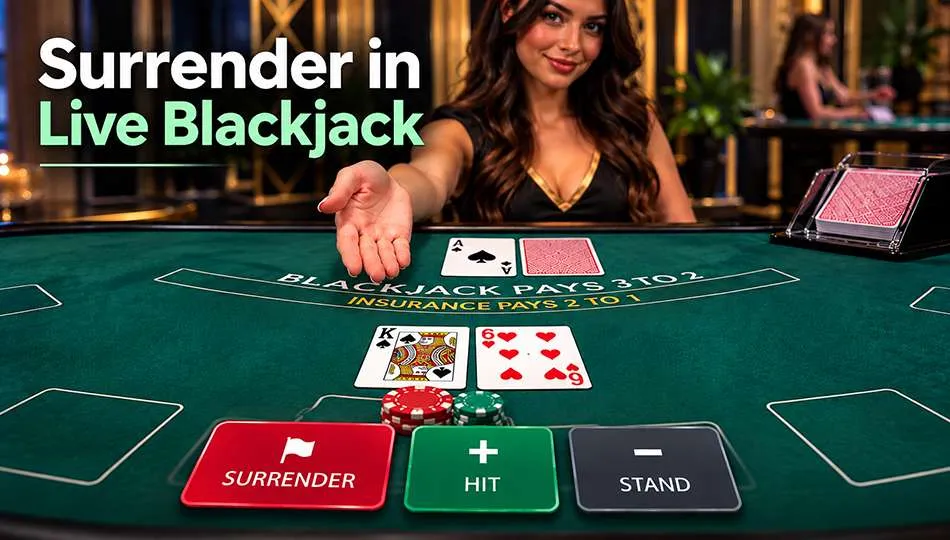
Not every live blackjack game offers surrender, and availability can differ between casinos running the same studio. The quickest check is the game’s rules or help screen: look for “Surrender” in the list of player options. At tables that offer it, a Surrender button appears next to Hit and Stand when your first two cards are dealt.
If you play blackjack regularly, a table with late surrender is slightly better value than an otherwise identical table without it. It is a small detail, but details like this are exactly what separates a good blackjack table from an average one.
Conclusion
Surrender will not turn blackjack into a winning game, but it is a useful tool when you know when to use it. If you remember just two hands, hard 16 against a 9, 10, or Ace, and hard 15 against a 10, you already have most of the value. Want to know which live blackjack tables offer the best rules? Read our live blackjack reviews and check each game’s rules before you sit down.