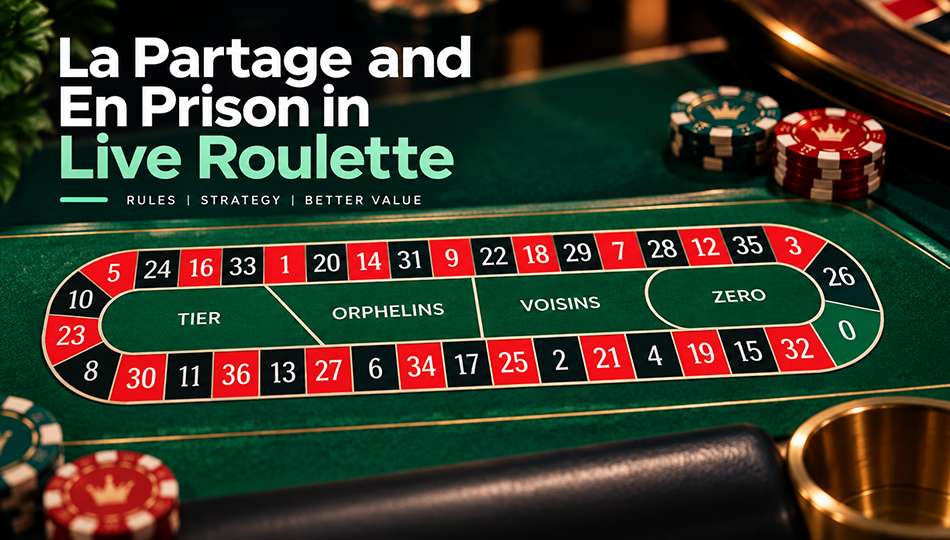
Most live roulette players know the difference between a single-zero and a double-zero wheel. Far fewer know that two small rule variations, la partage and en prison, can cut the house edge on even-money bets from 2.70% to 1.35%.
That makes a French Roulette table with la partage one of the best-value games in the entire live casino, yet it rarely gets the attention of the flashier multiplier tables. This guide explains what the two rules are, how they differ, how the maths works, and how to spot a live table that actually applies them.
What Is La Partage?
La Partage is French for “the sharing”. The rule applies only to even-money bets: red or black, odd or even, and 1-18 or 19-36. When the ball lands on zero, you do not lose your full stake. Instead, the casino takes half and returns the other half to you.
Say you bet £20 on red and the ball drops into the green zero pocket. On a standard European table, you lose the whole £20. On a la partage table, you get £10 back. The rule does nothing for inside bets, dozens, columns, or any other wager. It only ever comes into play on the six even-money options, and only when zero hits.
What Is En Prison?
En prison can produce the same 1.35% house edge as la partage, but the exact procedure after a second zero can vary between tables. Some rules keep the bet imprisoned for another spin, while others handle a repeated zero differently. Always check the table rules if en prison is offered.
Some tables add an extra wrinkle: if zero comes up again while your bet is imprisoned, the casino may either keep the bet imprisoned for another spin or take it, depending on the house rules. In practice, this is rare, and in live casinos, en prison is far less common than la partage because it complicates the betting flow when many players are at one table.
How the Two Rules Change the House Edge
Here is the maths in plain terms. A single-zero wheel has 37 pockets. An even-money bet covers 18 of them, so you win 18 times out of 37 and lose 19 times out of 37. That gap of one pocket is the casino’s advantage, which works out at 1/37, or 2.70%.
With la partage, the zero costs you half your stake rather than all of it. Your expected loss per spin therefore drops to half of 1/37, which is 1.35%. En prison can produce the same 1.35% house edge, although the maths works slightly differently. Instead of immediately losing half your stake when zero appears, your bet remains in play for the next spin. Under the standard French rules, the long-term mathematical effect is the same as la partage.
For comparison, here is how the main live roulette formats stack up on even-money bets:
– American roulette (double zero): 5.26% house edge
– European roulette (single zero): 2.70% house edge
– French roulette with la partage or en prison: 1.35% house edge
A 1.35% house edge is very low for roulette. However, some blackjack games played with perfect basic strategy can have an even lower house edge, while the standard Banker bet in baccarat is also slightly lower at around 1.06%.
Why Casinos Offer It at All
If the rule is so good for players, why does it exist? La partage and en prison come from the traditional French casinos, where they were part of the standard game.
When roulette moved online, providers such as Evolution and Playtech built French Roulette tables that kept the rule intact, partly because players expect it from anything labelled “French” and partly because the difference in revenue is small.
Even-money bets make up only a share of all wagers, zero appears roughly once every 37 spins, and many players never learn to seek the rule out. For a casino, it is a cheap way to offer a genuinely better product.
How to Find a Live Table With La Partage
Not every table called “French Roulette” applies la partage, and some tables that do apply it are not called French Roulette at all. Do not rely on the name. Instead, take these steps before you place a bet:
- Open the game rules or help menu inside the table lobby. The rule should be listed in the game rules or help menu if it applies, so look for the words “la partage” or “en prison” under even-money bets.
- Check the stated RTP. A live roulette table that lists 98.65% RTP for even-money bets is using la partage. A table that lists 97.30% for everything is not.
- Look at the layout. French Roulette tables often use traditional French names such as “Manque”, “Passe”, “Pair” and “Impair”, but confirm the rule in the help file anyway.
Evolution’s French Roulette and French Roulette Gold apply la partage, as does Playtech’s French Roulette. La partage can be found on French Roulette tables from major live casino providers, but always check the individual game rules because availability and rules can vary by table and market.
Multiplier games such as Lightning Roulette and XXXtreme Lightning Roulette do not apply la partage to their even-money bets. Their multiplier mechanics use a different payout structure from standard French Roulette.
Does La Partage Change How You Should Bet?
Yes, in one important way. On a standard European table, the house edge is the same 2.70% whether you bet on a single number or on red. That makes the choice a matter of taste. On a la partage table, the even-money bets carry a 1.35% edge while every other bet stays at 2.70%. If you want the lowest possible edge, you should keep your money on red/black, odd/even, or high/low and avoid mixing in inside bets.
It also makes some strategies less punishing. Flat betting on even-money outcomes at a la partage table gives you the slowest expected drain of any roulette approach. Progressive systems such as the Martingale still fail for the same reason they always do, which is that no rule change removes the negative expectation or the table limits, but the loss rate per spin is lower.
One caveat: la partage lowers the edge; it does not remove it. Over a long enough session, the casino still holds a mathematical advantage. Treat the rule as better value for your entertainment, not as a route to profit.
A Quick Comparison
| Rule | What happens on zero | House edge (even-money) | Common in live casinos? |
|---|---|---|---|
| No rule (European) | Full stake lost | 2.70% | Very common |
| La Partage | Half the stake returned | 1.35% | Common on French tables |
| En Prison | Stake held for next spin | 1.35% | Rare online |
Conclusion
La Partage and En Prison are the closest thing live roulette has to a free upgrade. They apply only to even-money bets; they only matter when zero hits, and they cost you nothing to use, yet they halve the amount the casino takes from those bets over time. If you like roulette and you like the even-money side of the table, seek out a live French Roulette table that documents the rule, confirm it in the help menu, and let the maths work slightly less against you.
Ready to try it? Browse our live roulette reviews to see which tables we have tested and how each one scores on payouts and fairness.